

Second Cut
Designer
Heidi Pierce
Country
United States
category
Fashion
Prize
Official Selection 2026

Short Description
Change the fabric. Change the silhouette. Change the city. The pattern comes with you.
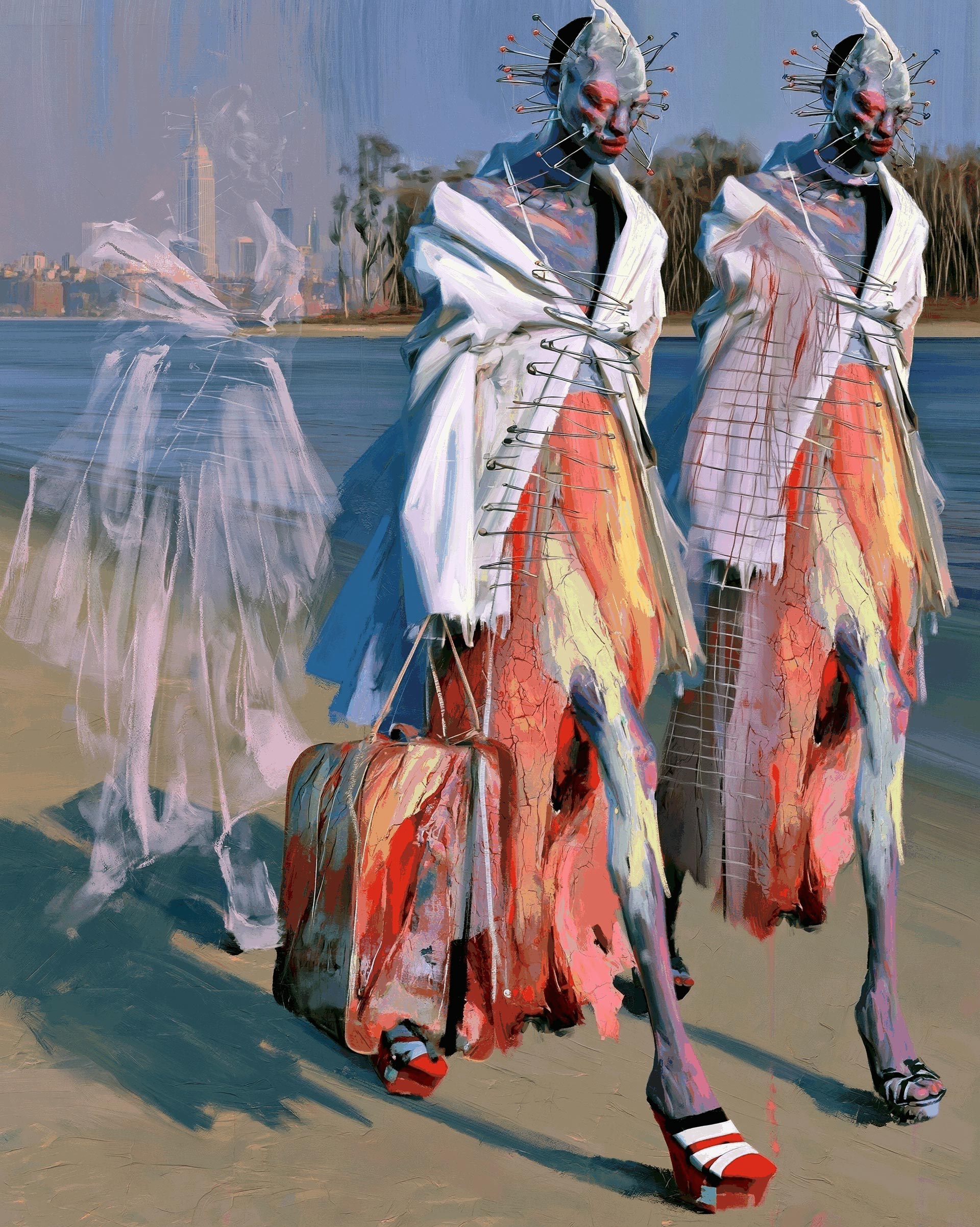
Second Cut considers reinvention and the patterns that survive it. A woman moves forward carrying a suitcase, her clothing reconstructed around her body. Behind her, another version follows, less resolved, its seams and construction still exposed. Further back, a spectral figure dissolves into the landscape.
Each appears to be a revision of the last. The clothes change. The surroundings shift. The woman keeps moving.
In garment construction, a pattern is the hidden architecture from which entirely different-looking clothes can be made. Psychological patterns can work much the same way. We change the visible things: our appearance, our surroundings, our relationships, the lives we build. Yet beneath those revisions, familiar structures can quietly remain.
The pins and exposed construction make that hidden architecture visible. What initially appears to be transformation begins to reveal repetition. The newest version may be more resolved than the one before it, but traces of the same underlying structure remain.
Second Cut asks whether reinvention is enough when the pattern itself remains unchanged.
Prompt Logic
The prompt began with the idea of construction left visible. Pins, raw seams and reassembled fabric became evidence of a woman mid-reinvention, each garment still carrying traces of how it was made.
Successive versions of the same woman move through a shifting landscape. The foreground figure appears the most resolved, the figure behind her is visibly under construction, and an earlier version has faded almost to a trace. The suitcase points forward. The other selves refuse to disappear.
Garment construction carried the real argument. A new garment may change its fabric, silhouette and finish without changing the pattern from which it was cut. By carrying that same construction through every version of her, the pattern stopped being about the dress and started being about her. Each attempt looks different. Something underneath keeps surviving the remake.
Process
The piece began with an exploration of deconstructed fashion and transformation. I was interested in clothing that revealed its own construction: pins left visible, seams exposed, garments appearing to be assembled or dismantled directly on the body.
One generated image shifted the idea in a more psychological direction. A woman appeared to be traveling through a landscape accompanied by another version of herself. The suitcase suggested departure, while the repeated figure complicated it. She could leave, but she could not leave herself behind.
That contradiction became the motivation for developing the piece. I became interested in the way we attempt to reinvent ourselves through external change: a different place, relationship, appearance or version of our life, while carrying forward patterns we may not recognize. Fashion offered a physical language for something largely invisible. A garment can look entirely new and still be cut from the same pattern.
I refined the figures so they would read as revisions rather than exact duplicates. The figure behind remains less resolved, with more visible construction lines and unfinished areas, while the foreground figure appears more complete. The spectral figure further back suggests an earlier version fading into the landscape. I kept recurring pins, seams and structural elements across the figures so that change and continuity could exist simultaneously.
The final image became less about transformation itself and more about what transformation fails to erase. The suitcase, changing landscape and forward movement all suggest that she is leaving something behind. The repeated figures quietly contradict that promise.
The title came from the language of garment making. Second Cut suggests another attempt, another version, another chance to construct something differently.
The fabric may change. The pattern travels with us.