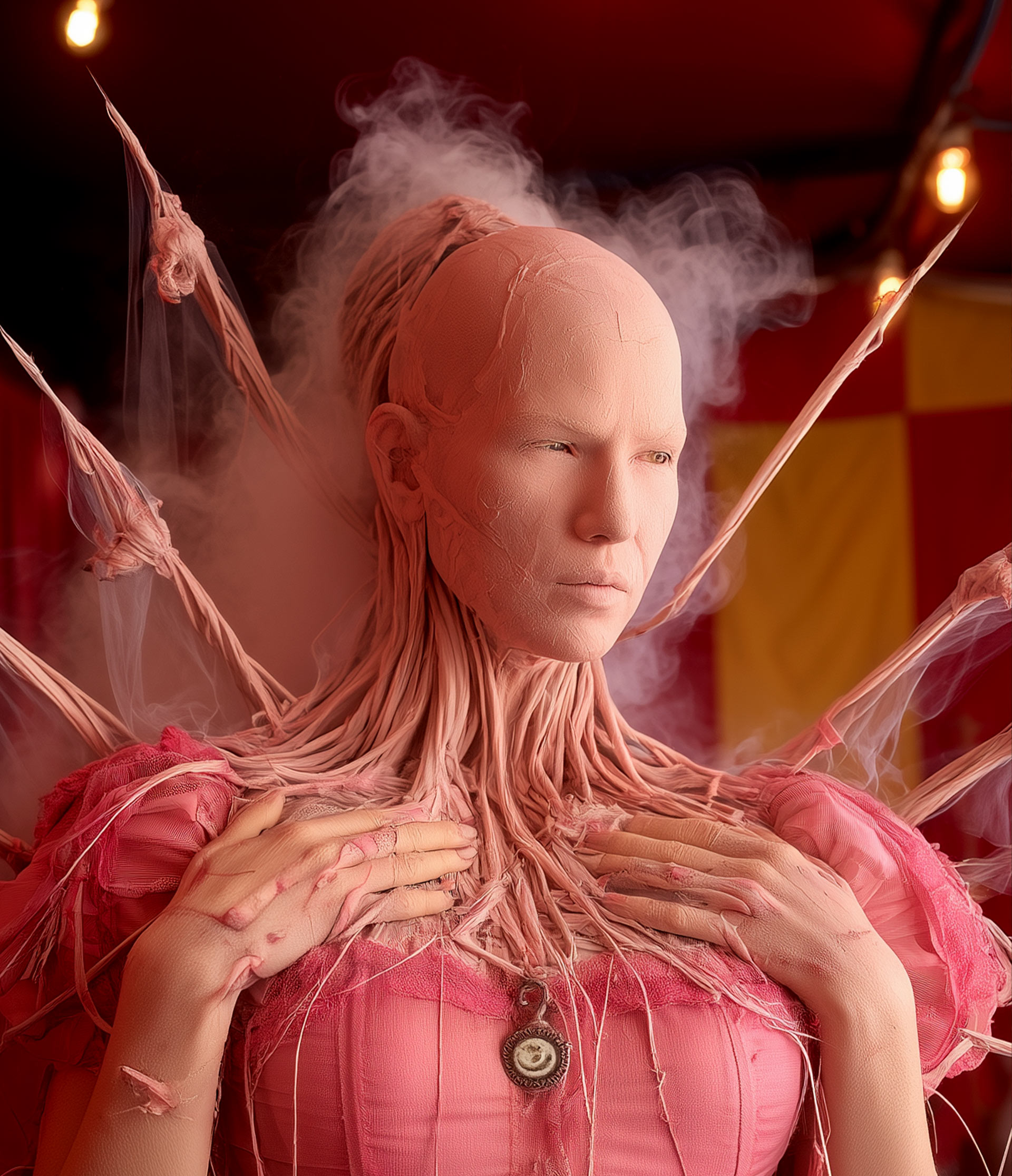
Freak show #14 – Metamorphosis
Short Description
The project operates as a visual laboratory in which the author explores and tests ideas through images, positioning themselves between reality and fiction, and navigating the space between documented time and speculative futures.
Prompt Logic
Hyper-realistic 1920s surreal freak-show portrait of a woman, keeping real facial structure, natural skin texture, pores, imperfections. scene set in a dreamlike, impossible carnival chamber where physical space bends subtly: walls curve inward like a ribcage, ceiling dissolves into a swirling fog that traces faint geometric patterns. lighting comes from multiple sources that shouldn’t exist soft glows suspended midair like floating orbs from broken stage bulbs. introduce strong surreal dream elements: her shadow splits into several silhouettes that act independently, each in a slightly different pose; thin streams of smoke emerge from her palms, shaping the outline of miniature faces whispering silently; an antique phonograph floats beside her, its horn bending like a flower and emitting no sound, only dust; a cracked pocket-watch hovers near her chest, its hands spinning backwards and casting impossible moving reflections on her skin; part of her dress evaporates into tiny moths midway down her torso, reforming themselves as fabric again near her knees. behind her, a distant carousel horse appears half-real, half-drawn, as if transitioning between worlds. the whole environment feels unstable, dream-thin, yet captured with Leica 1920 film realism, soft grain, authentic optical flaws. no illustration, no CGI, no smoothing just impossible phenomena photographed as if they were real.
Process
This project explores how objects and spaces — physical, digital, and conceptual — relate to one another through AI-mediated photography. In a world overloaded with speed and stimuli, it proposes a slower gaze toward what exists between action and perception, matter and imagination.
By blending original photographs with constructed environments, the work creates visual dialogues that question how we perceive space, the body, technology, and fiction. Each image emerges from a collision of realities — natural and artificial, human and machinic, tangible and cosmic — revealing the subtle tensions and silent gaps between them.
Within the broader framework of Freak Show, these images shift the idea of the “extraordinary” away from spectacle and toward perception itself. The strange is no longer a body on display, but the unstable boundary between realities. Spaces behave like characters. Objects feel staged. Technology becomes both lens and performer. What we see is familiar, yet slightly displaced — as if the world itself were posing.
Here, design is not merely a tool, but a poetic and critical space for reflecting on the present and speculating about possible futures. The project functions as a visual laboratory where the author mediates between reality and fiction, documentation and invention. Each composition captures a suspended moment — a quiet interval where the ordinary begins to look otherworldly, and the viewer becomes aware of their own act of seeing.
In this sense, Freak Show is not about exhibiting the unusual, but about revealing how perception itself produces strangeness.