
The Telematic Banquet

Short Description
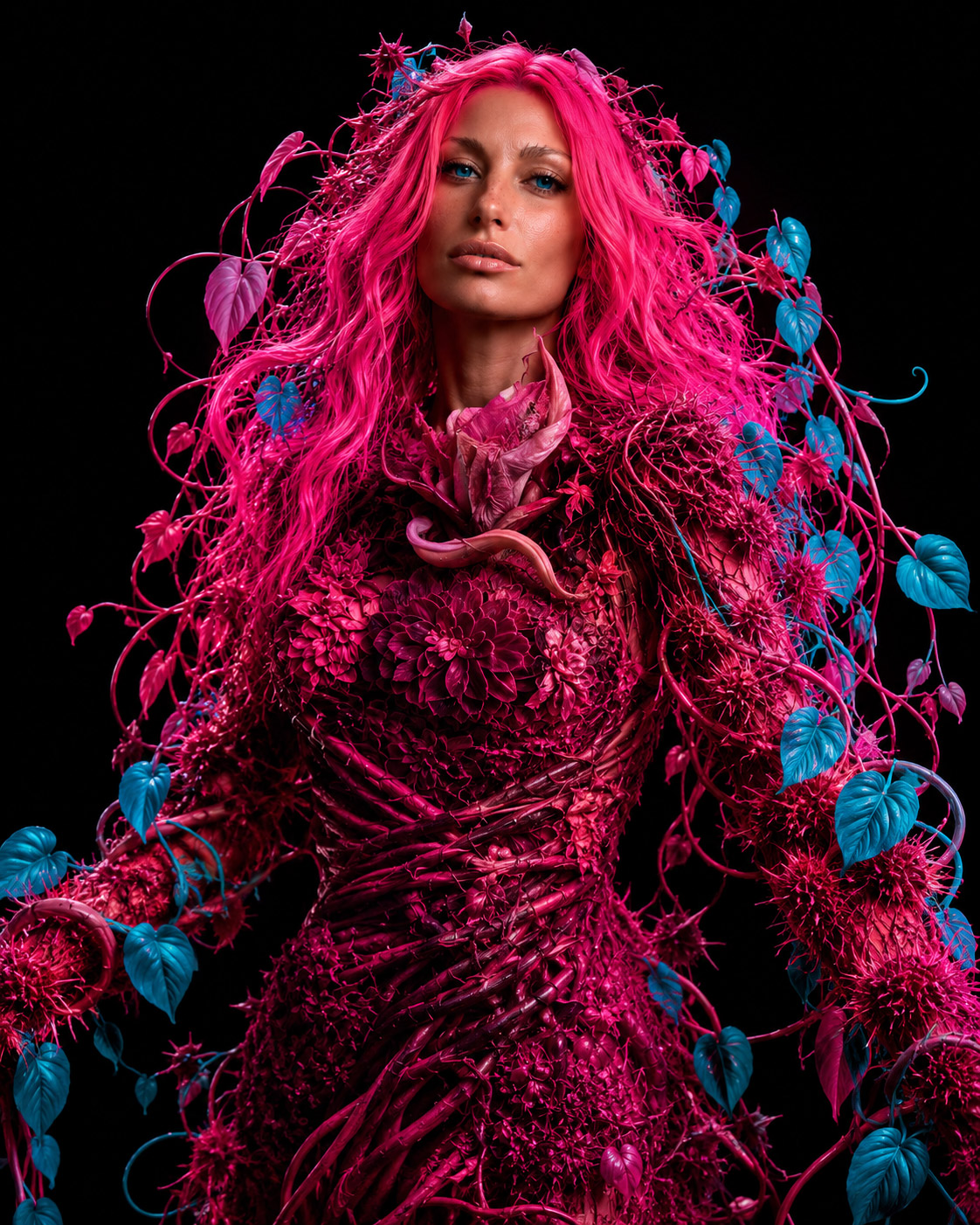
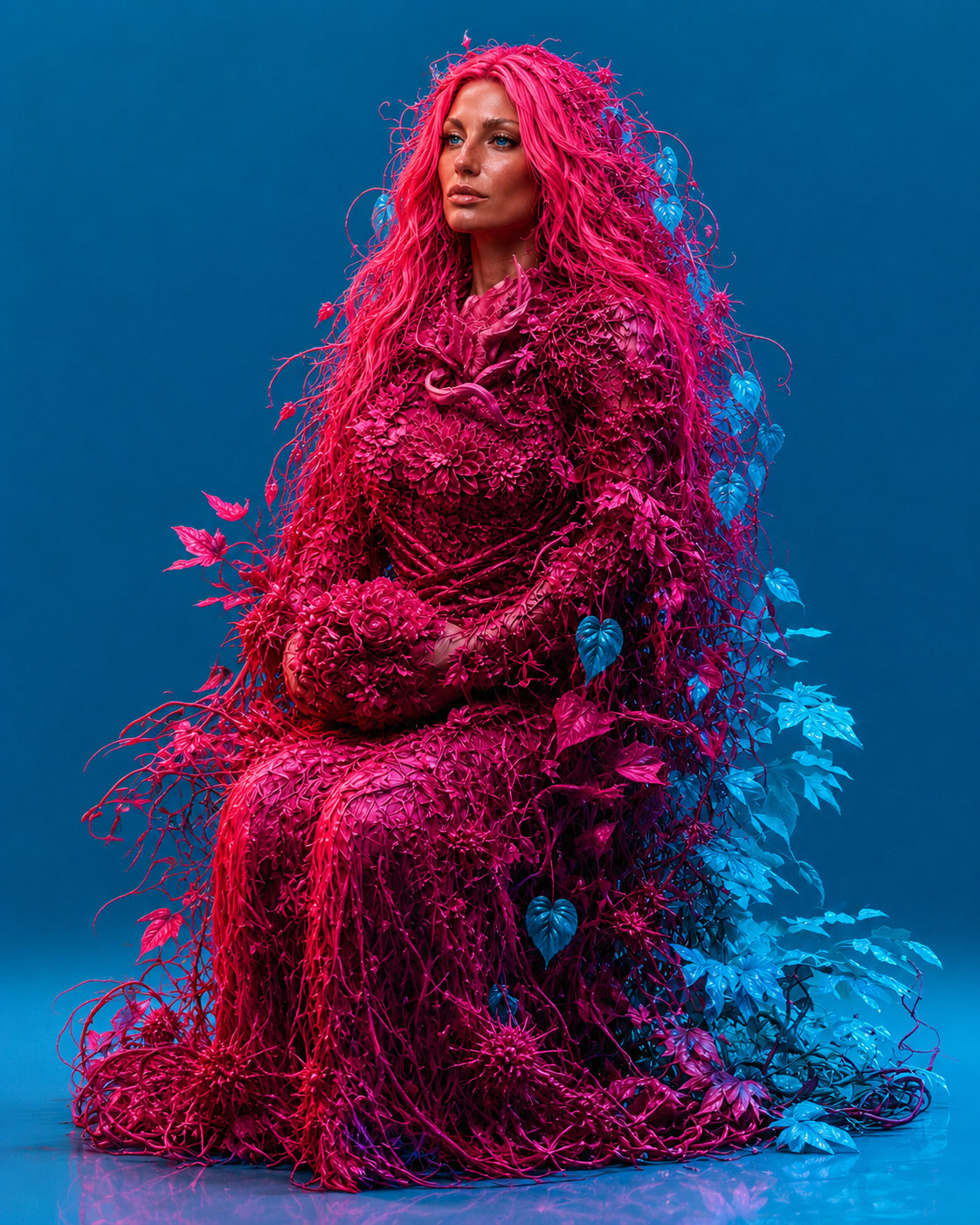
The Telematic Banquet interrogates the boundaries between the natural and the constructed, the organic and the fabricated. The botanical garment does not dress the body — it grows through it, indistinguishable from hair, from structure, from signal.
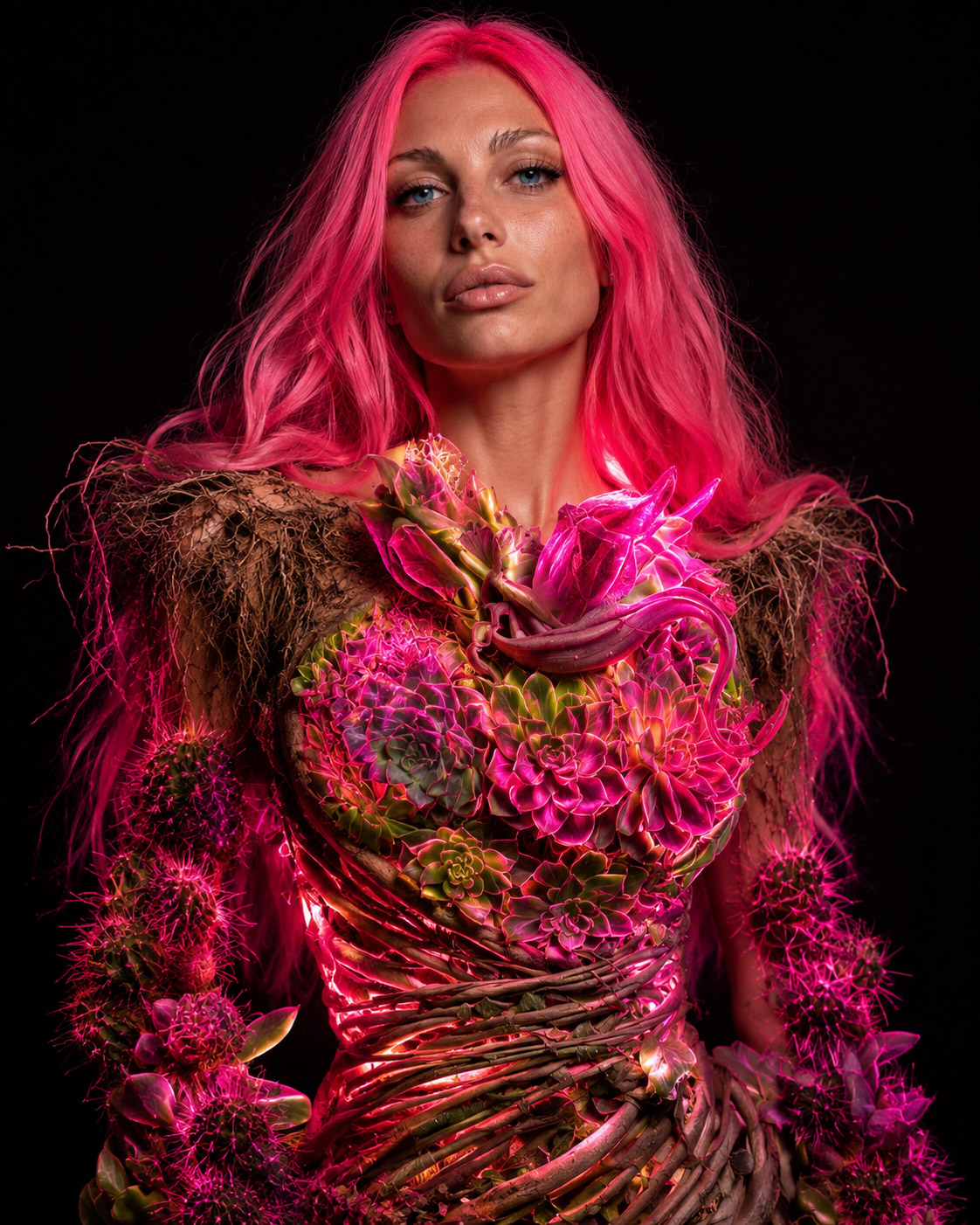
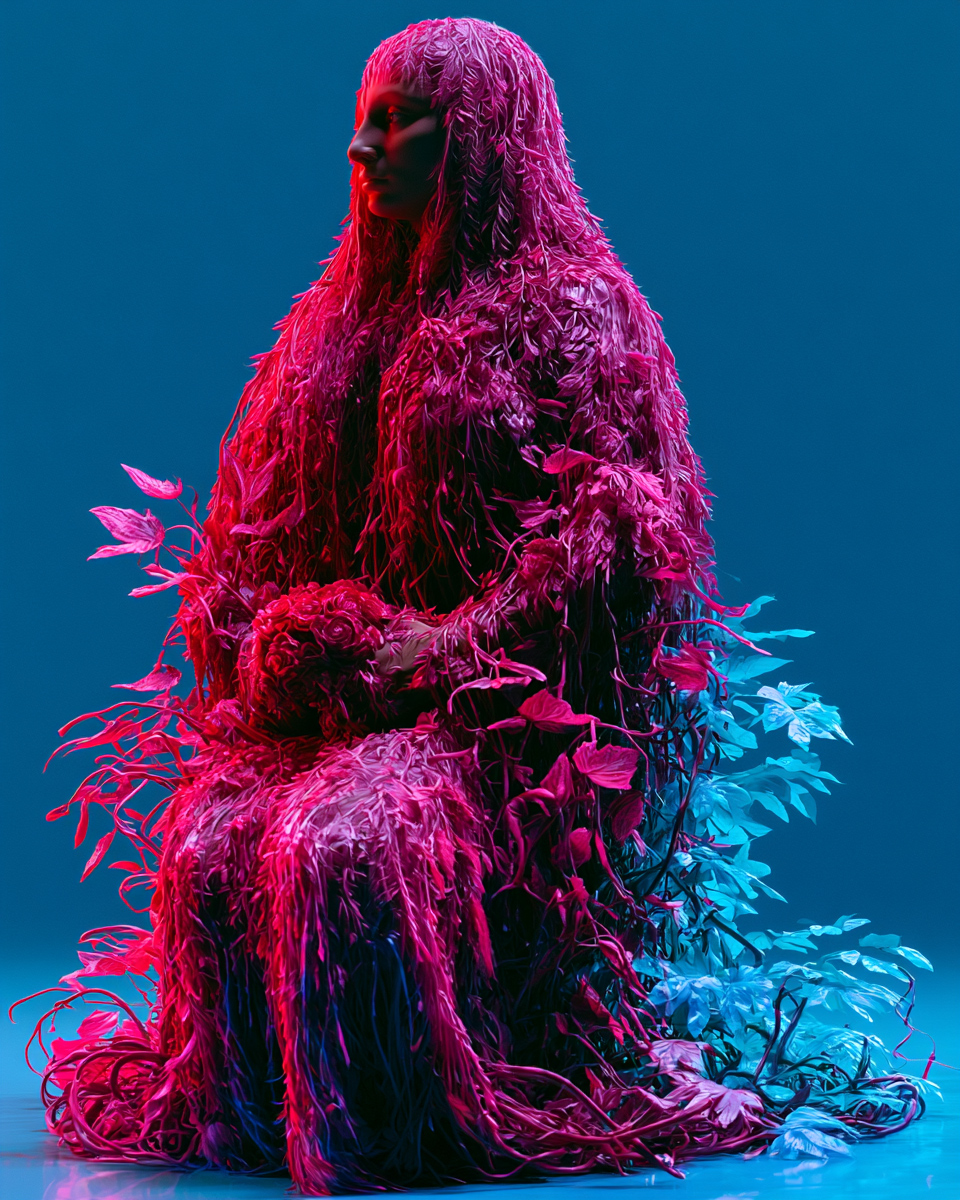
The garment functions as living architecture. Each zone of the body carries a distinct botanical language: succulents as armor at the chest, exposed root systems at the shoulders, climbing vines at the waist, a monumental crown that dissolves into hair. The silhouette is never fully closed — asymmetric elements on the outer edges dissolve the boundary between figure and ground. The garment expands into the environment, or the environment infiltrates the garment.
The leaves are not decoration. They are a question about where the body ends and the environment begins — and whether that distinction was ever real.
These plants were not found. They were generated. The garden grew inside the entity, and the entity cannot remember a time before the garden.
This is not a woman wearing plants. Everything you see grew from the flowers you cannot.
Prompt Logic
The following represents the final prompt logic — the conceptual and technical framework that defined the last iterations of the image. It reflects where the process arrived, not where it began. Each direction was refined across more than 40 generations before reaching this form.
1. Composition and framing
“Half-body shot, bust to waist. Three-quarter angle — body slightly turned, not straight frontal. Studio environment, controlled cinematic lighting. Single dramatic key light from slightly above, creating sharp shadow definition on face and collarbone. No natural light, no outdoor context. Pure background, no props, no additional elements. Vertical format, 4:5 aspect ratio, portrait orientation.”
2. Character definition
“30yo woman. Vivid hot-pink wavy hair, high volume, flowing freely — uniformly saturated from root to tip, no fading. Turquoise-blue eyes, intense — not grey, not light blue. Subtle freckles. Fair warm skin, natural texture, pores visible. Defined cheekbones. Full glossy lips. Elegant body, tall slim feminine curves. Calm, direct expression — not seductive, not aggressive. The face is the only unoccupied surface in the image.”
3. Garment structure by zone
“Botanical garment as living architecture — each zone of the body carries a distinct botanical language. Chest: succulents arranged as armor — dense, geometric, almost mineral. Shoulders: exposed root systems emerging outward — raw, structural, the underground made visible. Waist: climbing vines wrapping with controlled tension — tight but not aggressive. Arms: cacti with visible spines, neon-edged. Neckline: single large carnivorous flower, oversized, unnaturally perfect. Crown: monumental botanical structure that dissolves into hair at its base — the point where garment and body become indistinguishable.”
4. Body and garment relationship
“Full coverage — zero exposed skin, zero cleavage, zero décolleté. The plant structure covers everything. However, the body’s volume and silhouette remain readable through the garment — the botanical layers conform to the body’s curves from the exterior, creating a sculptural outline. The garment does not flatten the figure. It maps it. Covered but present — dressed, not erased.”
5. Palette and figure-ground boundary
“No green anywhere — not in leaves, not in stems, not in succulents. No natural tones, no earth browns, no organic references. Fuchsia and deep magenta as the dominant chromatic field — the same saturated fuchsia as the hair, with slightly deeper tones in the garment structure to create internal contrast. Deep blue flat background — saturated, graphic, not atmospheric. Asymmetric cyan leaves on the outer right edge only — specific leaves, not a gradient, same chromatic frequency as the background. The silhouette is never fully closed — figure and background share tone at the edges, creating controlled ambiguity about where the entity ends and the environment begins.”
Process
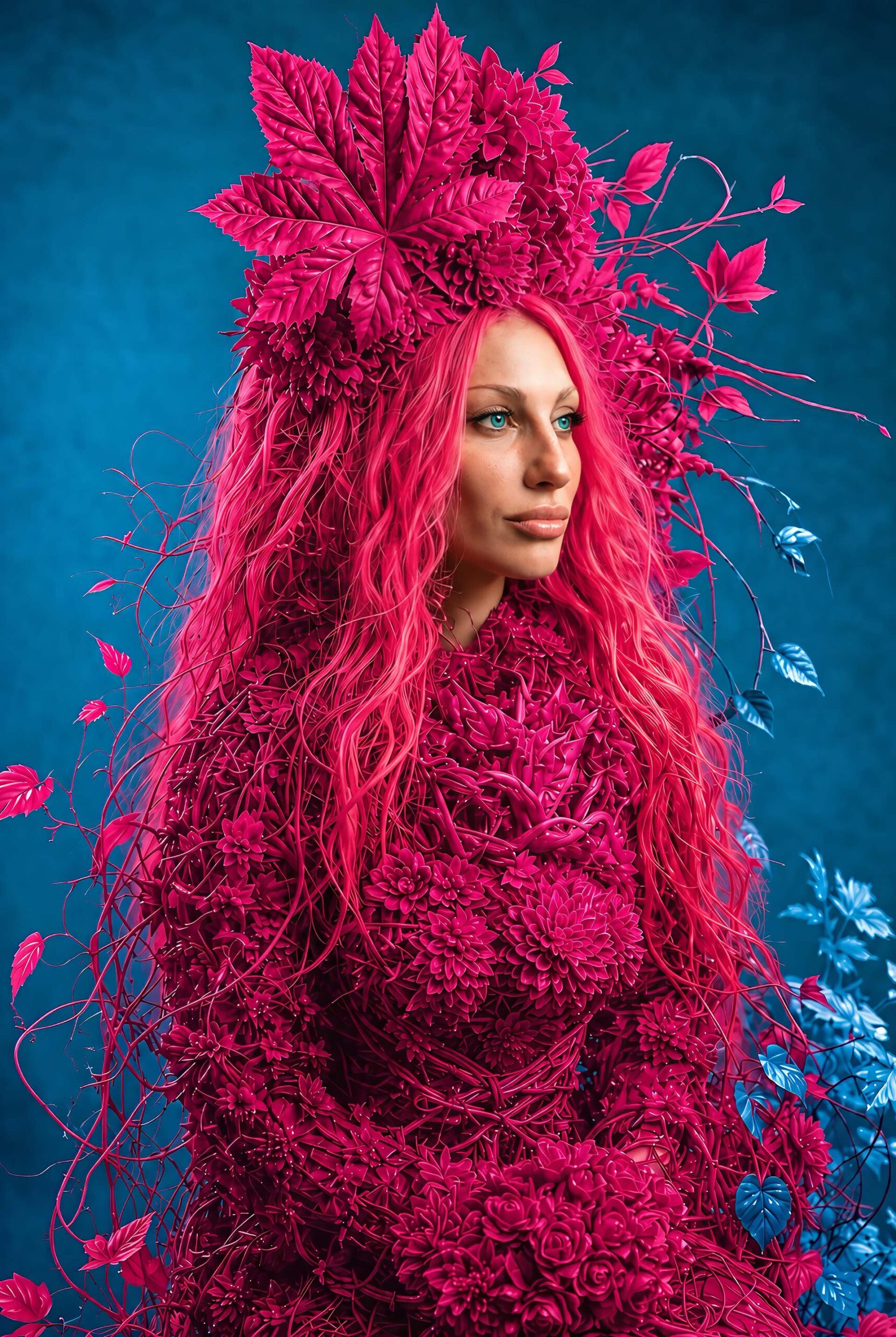
Over 40 generations across an iterative, non-linear process — moving continuously between Midjourney and ChatGPT image generation, using Lady Retrox reference images throughout. Each platform served a specific role: Midjourney for structural and botanical base generations and — in later stages — for combined prompts focused specifically on the garment structure and its ramifications; ChatGPT for character integration and successive color refinement; Nano Banana 2 for fine detail enhancement.
The process was not linear. Each generation informed the next prompt decision — results were manually selected, compared, and used as reference inputs for subsequent iterations. At multiple stages the process returned to Midjourney with new combined prompts to resolve specific zones: the crown structure, the hair-plant fusion boundary, the garment ramifications, the asymmetric edge elements. No single generation was accepted as final — every result was evaluated against the conceptual framework and either advanced, discarded, or used as partial reference for the next attempt.
Character consistency was maintained throughout by working with a fixed set of Lady Retrox reference images, applied across platforms. The character’s facial features, hair color and volume, and body structure were anchored by these references at every stage — preventing drift across iterations and ensuring the final image belongs to a defined visual identity rather than a generic AI aesthetic.
Beyond generation: each iteration involved manual selection of the strongest results, followed by color grading, lighting adjustments, chromatic profile alignment across the fuchsia/cyan/deep blue palette, silhouette refinement, and detail work on specific zones. Color decisions were made deliberately at every stage — managing the relationship between the fuchsia figure, the deep blue background, and the cyan accent elements to maintain chromatic coherence without flattening the internal contrast of the garment.
Final upscaling with Topaz Photo AI using conservative settings to preserve AI texture integrity — avoiding over-smoothing and retaining the organic irregularity of the botanical surfaces.