
The Fabric of Time

Short Description
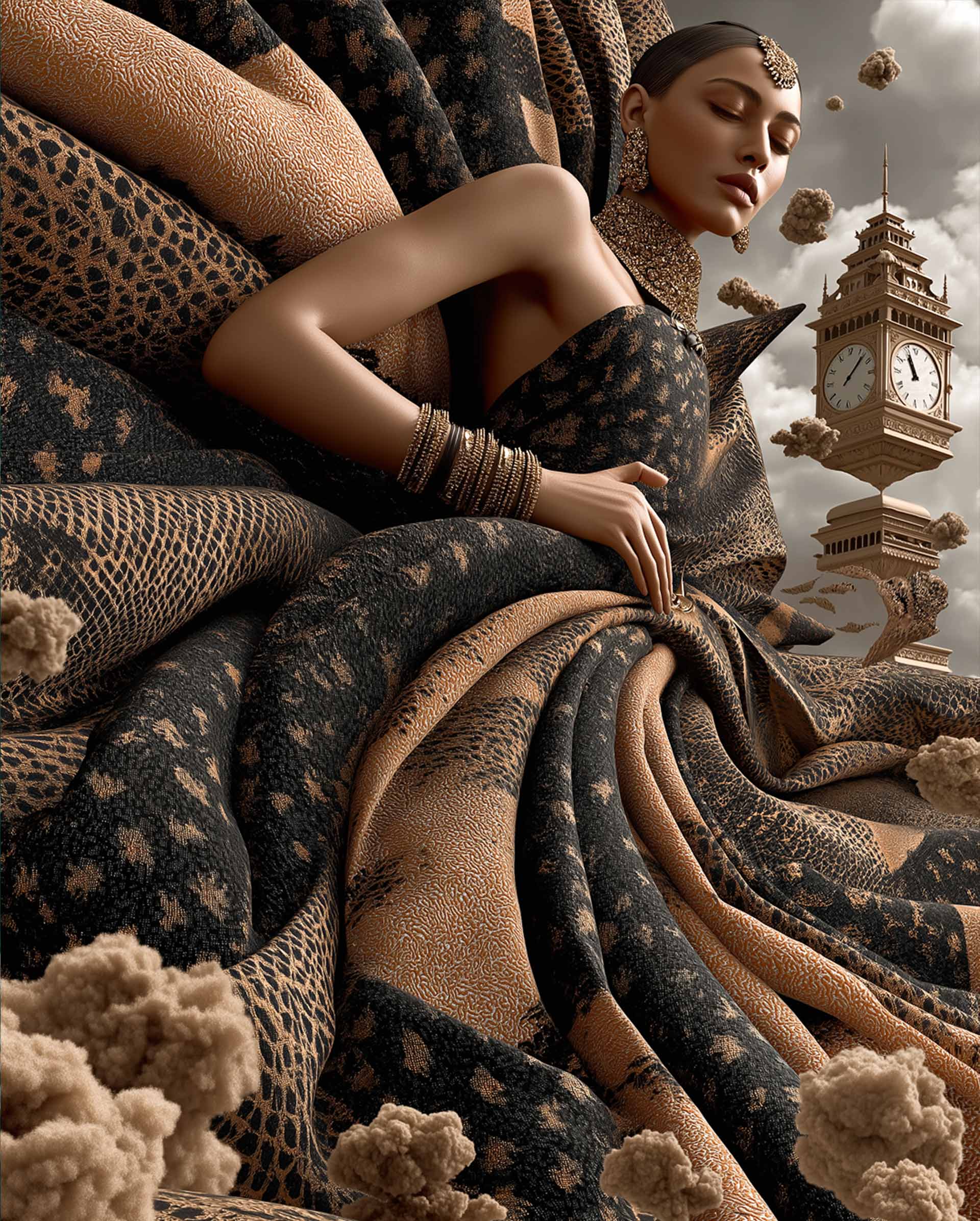
This project dives into time, memory, and tradition through fashion and surrealism. It’s inspired by my childhood memories of my mom’s sarees and the clocks that were always around us. The saree symbolizes time moving forward with the person wearing it while still holding onto bits of the past. The main image features a stunning woman in a black-and-gold bridal saree that transforms into a clock, attempting to mix fashion style professionalism with intentional and minimal surrealism through scale and framing. It shows the push and pull between tradition and change, beauty and oddity, highlighting how our personal stories can turn into broader reflections on culture, heritage, and transformation.
Prompt Logic
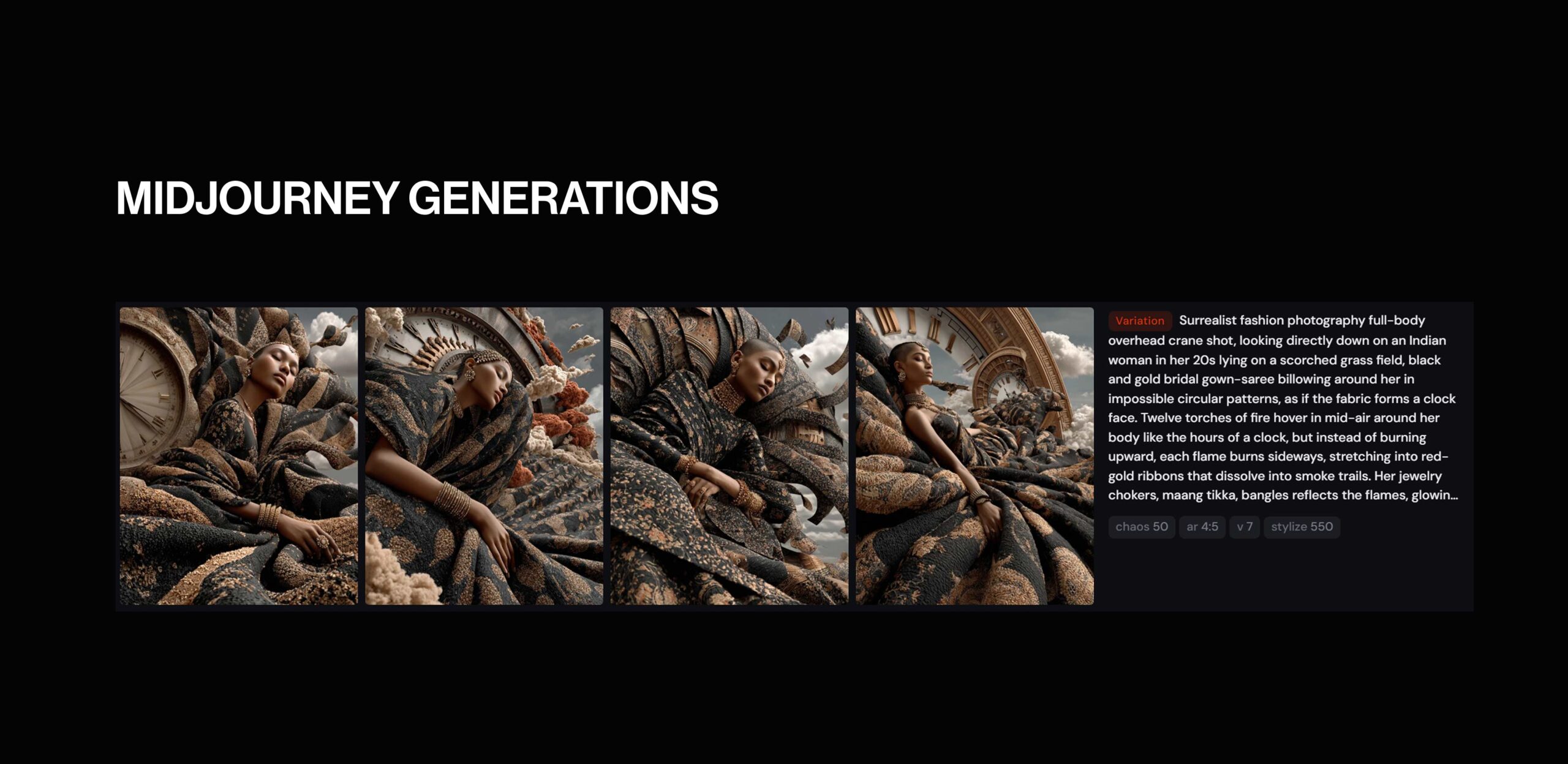
This prompt aims to bring the idea of time as a cycle filled with memories to life through a surreal fashion perspective. Picture an overhead shot of a young Indian woman in her 20s, wearing a stunning black-and-gold bridal saree that flows into beautiful circular shapes, creating a clock face that symbolizes time looping back on itself. Around her, twelve torches mark the hours, with their flames flickering sideways and turning into black-gold smoke, showing how time can feel like it’s melting away. Her jewelry—like chokers, maang tikka, and bangles—catches the light of the flames, highlighting the blend of tradition and change. The burnt grass field hints at the fleeting nature of life, while a distant mirror-archway adds a layer of depth, suggesting reflection and memory. With ultra-detailed textures and a painterly surreal style, this piece balances deep concepts with a high-fashion vibe, making the themes of tradition, time, and transformation visually captivating. The prompt went through multiple iterations to capture the essence of time at a distance and the sleeping model with the spreading saree as the symbol.
Process
“The Great Turn” grew out of something deeply personal. I’ve always been fascinated by time, not just as numbers ticking away but as something cyclical, looping back into itself. At home we’ve always had clocks, two in my grandma’s room, one in mine, two in parents’ room, one in the kitchen and one in the shared washroom. As a child I would ask my mother about the stories behind her sarees as she wore them and why she had to wear something that looked so complex. Multiple folds, 4 pins to keep it together, it just seemed tedious. Those memories connected in my head as I was staring at the clock as my mother was packing her sarees. Then it struck me, saree, with its endless folds, became the perfect metaphor for time: flowing forward with the wearer but always trailing behind, carrying fragments of the past for everyone to see.
From the beginning of this process, I knew I didn’t want to stop at a simple concept or symbolic photo. I wanted to push it further to make an image that looked like it belonged in a high-end fashion editorial while also functioning as a conceptual artwork. The challenge was to bring the two together. Fashion focus brought the finish, the glamor, the sense of immediacy. Surrealism gave me the freedom to bend reality and explore transformation. Together, they created the tension I was looking to express, something beautiful, but also strange, reflective, and layered with meaning.
The central figure in this image, a giant woman in a black-and-gold bridal saree, her gown expanding into the form of a clock became the key element. She became both subject and symbol. With her eyes closed in surrender and sleep, she carried the weight of tradition but also suggested release, a quiet comfort in letting go. Her jewelry shimmered like liquid gold, not just as decoration but as a metaphor for inheritance: customs that are heavy, yet precious, reshaped with each generation.
The process was iterative and the visual direction took shape with each MidJourney generation. I played with angles, scales, and lighting, sometimes exaggerating surreal elements, sometimes pulling back to maintain elegance. Each round showed me what mattered most—the scale that made the woman monumental, the bending clock that intertwined time and fabric, the expressions that grounded the surrealism in human emotion. I learned to refine without losing intensity, keeping the balance between editorial polish and conceptual strength.
The greatest challenge was in finding this balance. Too much surrealism, and the image risked becoming an abstract fantasy, detached from the fashion language I wanted to retain. Too much emphasis on fashion polish, and it could have slipped into being just another glamour shot, stripped of conceptual weight. Navigating that middle space—where surrealism and fashion meet, where tradition and transformation overlap—took time and persistence.
In the end, the image became what I had hoped for: an editorial-style portrait that also functions as a meditation on time, culture, and change. It honors the saree as both fabric and metaphor—endless, cyclical, charged with memory—while also pushing its representation into new territory. This piece is an attempt to show how something deeply personal, like the conversations with my mother about her sarees, can be reshaped into an artwork that speaks to broader ideas of fashion, tradition, inheritance, and transformation borne out of history and applicable in the modern context as well.